


Responsible AI and Tech Justice for K12 Education

Our Goal
The advancement and proliferation of AI technologies continue at a rapid pace, with both promise for positive impact and potential for exacerbating harm. In K-12 education, there is an urgent need to ensure all students and teachers are equipped with the knowledge, skills, and resources to move beyond simply the adoption of AI tools, and become critical consumers and producers of the next generation of AI technologies.
We envision a computing education ecosystem where all students experience inclusive and equitable learning environments that enable the interrogation of the creation of technology, the examination of ethical concerns, risks, and harms, and the building of knowledge to harness the power of computing for justice.
Responsible AI and Tech Justice is a robust and comprehensive course of study that utilizes an explicit racial and social justice lens to equip all students with the knowledge and resources to critically interrogate the ethical and equitable development, deployment, and impacts of AI, while simultaneously challenging, disrupting, and remedying the harms that these various technologies can cause within individual’s lives, communities, and society at large.
“We need people designing technologies for society to have training and an education on the histories of marginalized people, at a minimum, and we need them working alongside people with rigorous training and preparation from the social sciences and humanities.”
– Dr. Safiya Umoja Noble, Algorithms of Oppression: How Search Engines Reinforce Racism
The Guide
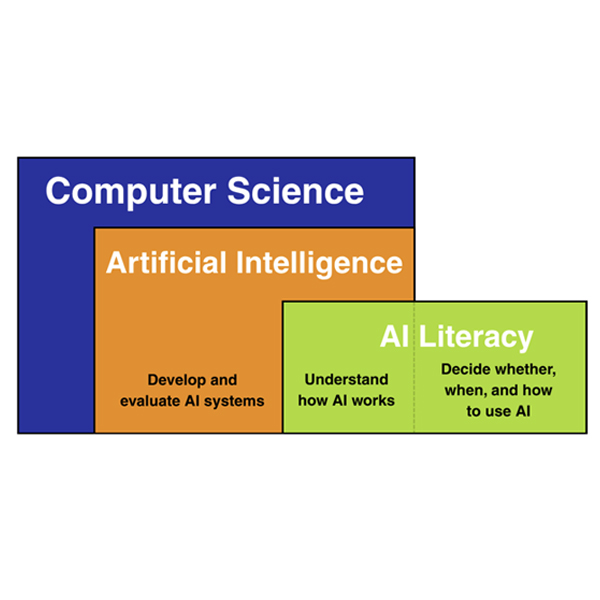
In 2024, we articulated a vision for Responsible AI and Tech Justice in K-12 education and provided a set of core components and interrogation questions to guide exploration of AI. In this updated 2026 version of the guide, we (a) align our vision for Responsible AI with a shared definition of computer science and AI literacy, specifically that “AI literacy requires a foundation in CS. AI literacy is essential, but not a substitute for, AI education: teaching only tool use leaves students able to operate AI, but not able to build or evaluate it,” (b) further define responsible AI literacy as a set of skills and dispositions that all critical consumers and responsible producers of AI should develop, to cultivate agency and clarity about the purpose, limits, and consequences of AI tools, (c) articulate a set of six core competencies that describe responsible AI literacy and align with the six core components, and (d) provide a set of sample interrogation questions, segmented by grade level, and aligned to the new CSTA K-12 CS standards.

Core Components
The six core components serve as a guide for educators, parents, policymakers, and advocates seeking to design learning experiences for students and teachers aligned to the vision of justice-centered computing education, where both the critical interrogation of technologies and the disruption and creation of more ethical and equitable solutions are prioritized.

Core Competencies
The six core competencies are a list of the skills and dispositions that responsible, AI-literate individuals strengthen and develop to become critical consumers and responsible producers of AI tools.
Algorithmic Awareness
Data
Fluency
Ethical
Design
Environmental Consciousness
Human-Centered Agency
Dynamics of Power
AI, Racial Justice and Our Future
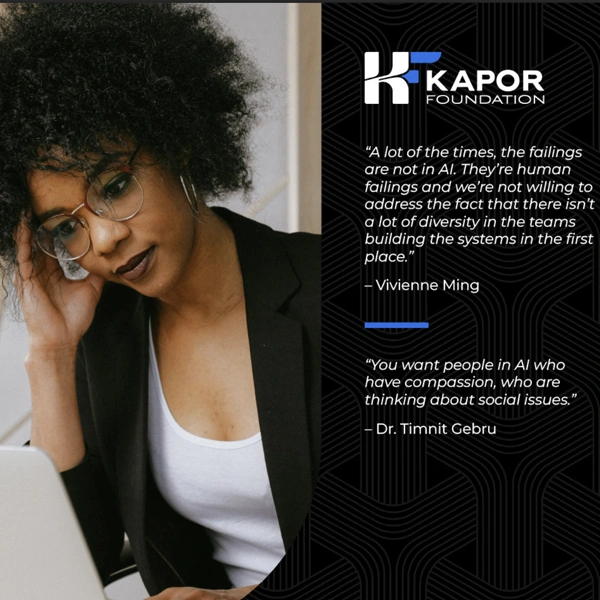
Leading AI researchers and experts Alex Hanna and Timnit Gebru from the DAIR Institute engage with Mitch Kapor, Co-Chair of the Kapor Center, to discuss the ethical harms that exist within AI, emerging technologies, and the future direction of AI and AI research.

